


A hailstorm rolls through Fort Worth on a Tuesday afternoon, and by Friday half the block has adjusters in the driveway. Three months later, one of those neighbors gets a job offer in another state, but her roof claim’s still open. She assumes she’s stuck, so she turns the job down.
She wasn’t stuck. Not even close.
Selling a Texas home with a pending insurance claim happens constantly, and most of the time it closes on schedule. What changes is the paperwork, the negotiation, and who ends up holding the check, so the sellers who struggle are almost always the ones who never asked the question in the first place. I’ve bought houses in this exact situation across Texas.
What Does a Pending Insurance Claim Mean for Your Texas Home Sale?
Before: a seller in Garland has an approved wind claim, a signed contract, and a buyer with conventional financing. After: the lender finds out about the open claim at underwriting review, and the whole thing pauses for three weeks while everyone argues about the roof.
A pending insurance claim is just a claim you’ve filed that hasn’t been paid, closed, or fully settled. Maybe the adjuster came out but the check hasn’t cleared. Maybe you got a partial payment on the roof and the supplement for interior water damage is still in review. Real clocks are placed on this process by Texas law, so you aren’t waiting indefinitely by design.
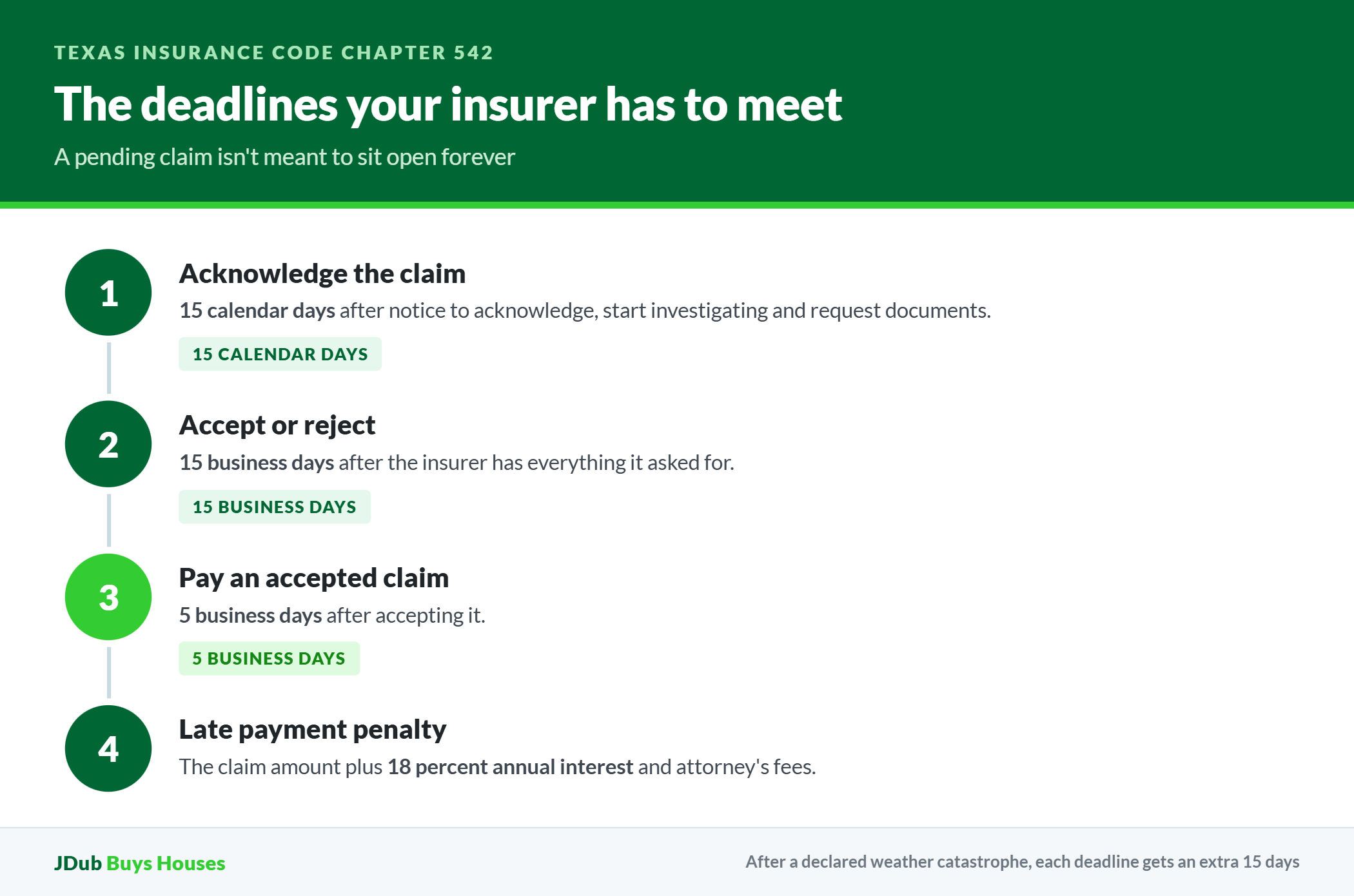
Under Chapter 542 of the Texas Insurance Code, your carrier has 15 calendar days after receiving notice to acknowledge the claim, start investigating, and ask for the documents it needs. Once it has everything, it gets 15 business days to accept or reject, then five business days to pay an accepted claim, so the whole process has real deadlines baked into it. Miss those deadlines and the insurer can owe you the claim amount plus 18 percent annual interest along with attorney’s fees, as this breakdown of the prompt payment rules lays out.
Those deadlines stretch after a declared weather catastrophe. Each one picks up an extra 15 days.
So why do so many Texas claims sit open for months? Insurers reopen files, argue over scope, and send out appraisers, and each round adds weeks. A claim that’s been reopened twice can easily outlast your listing, your contract, and your patience. The practical problem is this, not the legal one.
Can You Sell a House in Texas with an Open Insurance Claim?
Maria’s roof had hail damage and a pending claim when a buyer made an offer, and she wondered if Texas law would stop the sale. Nothing in Texas law prevents you from selling a house while one is pending. No statute, no licensing rule, no title requirement. The friction comes from your mortgage lender, the buyer’s lender, and the language inside your own policy.
Yes, you can sell. What happens to the money matters most.
Claim proceeds belong to whoever owned the property when the loss happened, unless you assign them, which means the purchase contract matters more than anything else here. Either you keep the payout and sell at a reduced price reflecting the damage, or you assign it to the buyer and price accordingly. Both kinds of sales close in Texas every week.
I worked with a widow in Pflugerville not long ago who’d been handed a transfer date and five weeks to be out. Her kitchen ceiling was still open from a plumbing leak, the claim was half paid, and her late husband’s woodworking tools filled the garage. We took the house with the damage, let her keep the first payment she’d already received, and she made her move date with time to spare.
Sellers in Texas need to time it better than expected right now, since the market gives less cushion than it did three years ago. Statewide median days on market hit 82 in March 2026, up 12 days from the prior year, according to data compiled by the Texas Public Policy Foundation. A pending claim on top of that timeline can push a traditional listing into a long, expensive wait.
How Does a Pending Insurance Claim Affect Your Home’s Title?
“Will this show up on my title search?”
Usually not, and that surprises people. A pending claim isn’t a lien, a judgment, or a recorded encumbrance. Your title company pulls deeds, mortgages, easements, tax records, and court filings; an open claim with your carrier lives nowhere in those records.
Where it does show up is in the contractor’s paperwork. A roofer or restoration company that did work and hasn’t been paid can file a mechanic’s lien against your Texas property, and that absolutely lands on the title search. I’ve seen more closings delayed by an unpaid restoration invoice than by the claim itself.
Your mortgage lender adds its own wrinkle to the mix. When a claim check arrives, most Texas mortgage servicers require it be made out jointly and deposited into an escrow account, released in draws as repairs progress. Selling before those funds are released means your title company has to account for money the servicer is still holding. A phone call early solves it, not the day before closing.
Talk to your title company at the start. Not the week of funding.
One more wrinkle worth raising with your closing agent: your title policy covers defects in ownership, not property damage. They’re two different types of insurance serving two unrelated purposes, yet plenty of Texas sellers conflate them. The Texas Department of Insurance publishes its title insurance claims handling standards if you want to see where that line sits.
Do Buyers in Texas Care About an Active Insurance Claim?
For years I assumed an open claim would scare off every retail buyer who walked through the door. I was wrong, because it depends entirely on who the buyer is and how they’re paying.
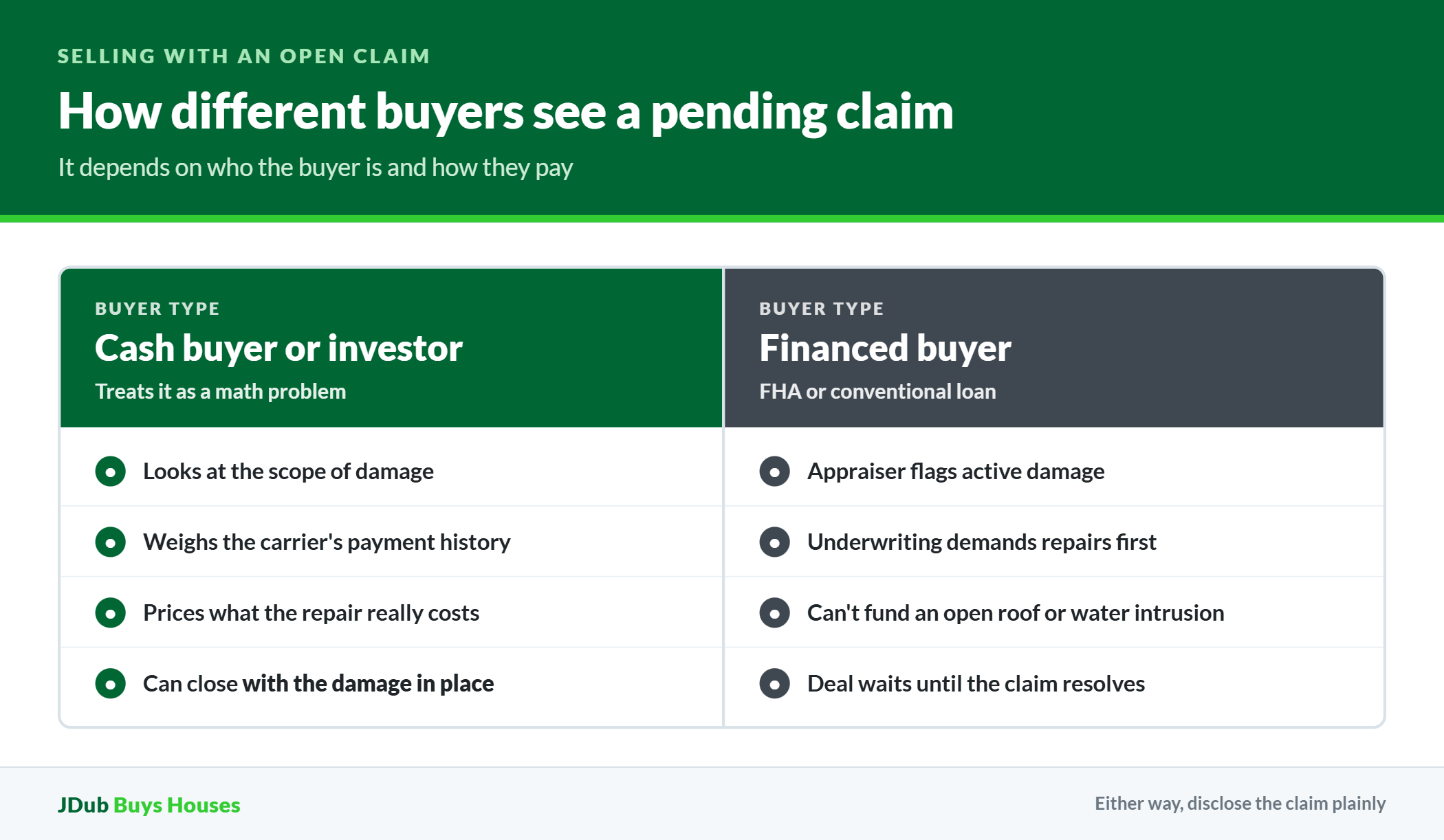
Cash buyers and investors treat a pending claim as a math problem. We look at the scope of damage, the carrier’s payment history on the file, and what the repair genuinely costs. Nobody panics.
Financed buyers are a different animal. FHA and conventional lenders won’t fund a home with active structural damage, an open roof, or unrepaired water intrusion. Their appraiser flags it, underwriting demands repairs before closing, and now your buyer is waiting on it to resolve before they can get a mortgage loan. That’s where sales die.
Buyers in this market also have leverage they didn’t have in 2021. In the Austin metro, the median home price in October 2026 was $404,802 across the region, down almost seven percent year over year, per Austin MLS data reported by CultureMap. Give buyers options, and a house with an unresolved insurance claim moves to the bottom of their list.
Does that mean you should hide it? Absolutely not. Texas sellers using the standard seller’s disclosure notice have to report known defects and prior claims, and a buyer who discovers an undisclosed insurance claim after closing has every reason to come after you. Disclose it plainly and price it honestly. That combination sells houses; concealment creates lawsuits.
Should You Settle Your Insurance Claim Before Listing in Texas?
Waiting to settle your insurance claim before you list is usually the wrong call for anyone on a deadline.
The reasons are straightforward. Carrying costs don’t stop while you negotiate scope with an adjuster. Mortgage payments, property taxes, insurance premium, utilities on an empty house: that’s real money leaving your account every month the claim stays open.
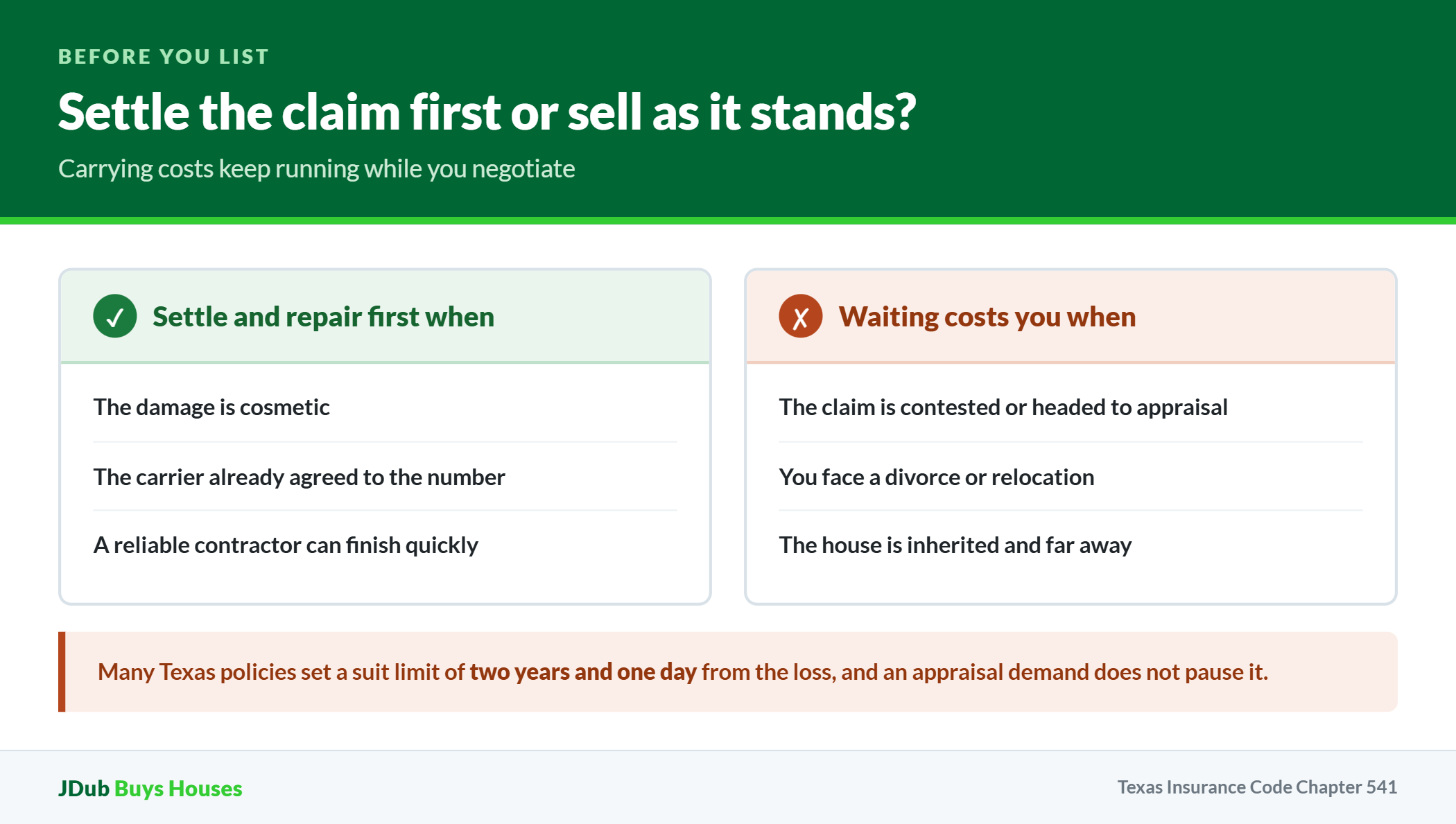
Settling first makes sense in one scenario. If the damage is cosmetic, the carrier has already agreed to the number, and you can complete repairs quickly with a reliable contractor, you’ll net more by fixing and listing clean. Hail-damaged shingles on an otherwise solid home in Plano? Repair it, then sell.
Once the claim gets contested, settling first stops making sense. Appraisal and litigation in Texas drag on, and the limitations clock keeps running regardless. Texas policies commonly include a suit limitation of two years and one day from the loss. Claims under Chapter 541 of the Texas Insurance Code carry their own two-year deadline, which an appraisal demand does not pause. A Texas firm’s write-up on bad faith claim deadlines explains that distinction well. If you think you’ve got a dispute, talk to legal counsel before you sign anything that assigns your rights away.
Would you rather hold a damaged house for eight months chasing a few thousand dollars, or sell now and move on? There’s no universally right answer. For sellers facing a divorce, a relocation, or an inherited property three hours away, speed wins.
Companies like JDub Buys Houses buy Texas properties with open claims specifically so sellers don’t have to make that choice under pressure.
What Happens to an Insurance Claim During Closing?
Everybody pictures the claim check arriving in the mail and getting deposited like a tax refund. Then the title company’s closing instructions arrive and the picture falls apart, because unresolved insurance proceeds get flagged as an unsettled financial interest in the property.
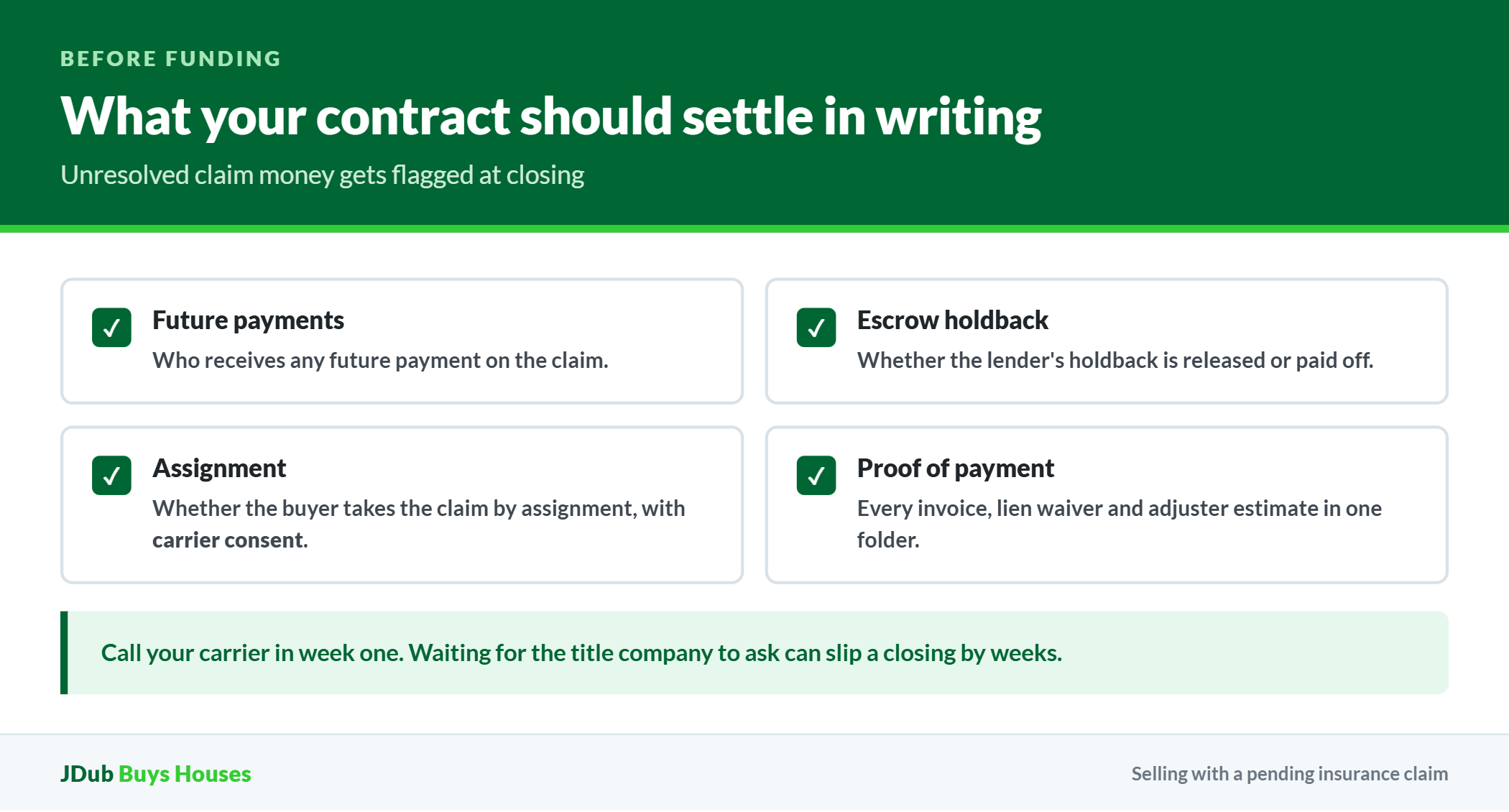
Three things get decided before funding. Who receives any future payment on the insurance claim, whether the mortgage lender’s escrow holdback is released or paid off, and whether the buyer takes the claim by assignment. Your contract should name all three in writing.
Most Texas policies require carrier consent to assign claim proceeds, so don’t promise a buyer something your insurance company hasn’t approved. I’ve watched a closing slip two weeks because nobody called the carrier until the title company asked for the assignment document. One phone call in week one prevents that.
The cleanest version is also the simplest. You keep the insurance claim. The buyer takes the house as-is at a price that reflects the damage. The carrier pays you after closing on the loss that occurred during your ownership of the property. Many Texas carriers will honor that; some won’t. Ask yours in writing.
If repairs were partly done, keep every invoice, lien waiver, and adjuster estimate in one folder. Your Texas title company will want proof that contractors were paid before it insures the buyer’s ownership.
Deadlines don’t pause for a closing. That’s worth repeating to anyone planning to settle the insurance claim later.
Key Takeaways on Selling with a Pending Insurance Claim
Get this wrong and you can hand a buyer the house, the damage, and your claim proceeds all at once, with nothing in the contract saying otherwise. I’ve seen sellers sign away rights worth more than their net proceeds because a single sentence was missing.
Document everything from day one of the insurance claim. Adjuster names, dates, estimates, emails, partial payments.
Tell your title company and both lenders about the open insurance claim before you’re under contract. Surprises at underwriting cost weeks. In a Texas market where Dallas-Fort Worth listings posted a median of 64 days on market in October 2026 per Realtor.com data tracked by FRED, you don’t have weeks to spare.
Price the damage honestly rather than hoping a buyer won’t notice. Texas buyers inspect, and inspectors find water stains.
A seller in Katy going through a divorce called me on a Saturday, boxes already stacked in the garage next to a boat neither spouse wanted. Their hail claim had been open since spring, and neither of them wanted to manage another adjuster appointment. We closed in under three weeks, split proceeds per their agreement, and nobody had to coordinate a roof replacement with an ex.
Selling to a direct buyer isn’t the right answer for everyone. If your claim is nearly settled and your house is otherwise market-ready, list it. If the damage is real and your timeline isn’t flexible though, an as-is sale is just arithmetic.
Frequently Asked Questions
Can I Sell My House in Texas While an Insurance Claim Is Still Open?
You can. Texas law doesn’t block the sale, and title companies close these sales regularly. What you need is a contract that spells out who keeps the claim proceeds, early notice to your servicer, and written confirmation from your carrier if the buyer is taking the claim by assignment.
How Long Do I Have to Take Legal Action on an Insurance Claim in Texas?
Most Texas property policies shorten the standard breach of contract window through a suit limitation clause, and statutory bad faith claims carry their own shorter deadline described earlier. Courts in Texas have enforced those clauses, and starting appraisal doesn’t stop the clock. If your insurance claim is headed toward a dispute, get an attorney’s read on your specific policy language rather than relying on a general rule.
Do I Have to Tell a Buyer About a Pending Insurance Claim?
Yes. The standard Texas seller’s disclosure notice asks about known defects and prior claims, so an open claim belongs on it. A buyer who finds out after closing has grounds to come after you. Telling them up front costs far less than that fight, and you can price the house to match.
Will a Pending Insurance Claim Show Up on My Title Search?
The insurance claim itself won’t. What can appear is a mechanic’s lien from a contractor who did repair work and never got paid, and that’s a genuine title problem your closing agent has to clear. Pull your invoices and lien waivers together early so the title company isn’t chasing paperwork during funding.
Does a Pending Insurance Claim Lower What I Can Sell for in Texas?
It can, though not always by the full repair cost. Cash buyers price the damage plus the hassle of managing contractors; financed buyers often can’t close at all until repairs are done, which shrinks your pool. If you keep the insurance claim proceeds yourself, the price reduction and the eventual payout tend to roughly balance out.
If you’re sitting on an open insurance claim and trying to figure out whether to repair, wait, or sell the house as it stands, we’re happy to talk it through with you. No pressure and no obligation, just a straight conversation about what your Texas property is worth in its current condition and what your realistic options look like. You can reach out through JDub Buys Houses whenever you’re ready, and if the right move turns out to be listing it or finishing the claim first, we’ll tell you that too.
Selling an Amarillo House With an Open Claim
Hail and wind claims are common in Amarillo, and we buy houses here with the damage still in place. Amarillo listings had a median asking price of $285,000 in October 2026, and the typical one had sat for 38 days. A house with an open roof or a contested claim usually takes longer than that to sell with a financed buyer.
We make the same offer to homeowners across Texas, so it doesn’t matter where the storm hit. You keep the conversation about the claim between you and your carrier, and we handle the house.
Get a Straight Answer on Your House
If you’re not sure whether to repair, wait on the adjuster or sell now, reach out to our team and walk us through the claim. You can also fill out the form below, and we’ll get back to you with a no-obligation offer for the house as it stands.
Helpful Texas Blog Articles
- Can you sell a House in Texas with a Tax Lien on it?
- Can I Sell My House for Less than Appraised Value in Texas?
- What Taxes Do You Pay When Selling a House in Texas?
- How to Sell a House with a Squatter in Texas
- Can You Sell Your House With A Quitclaim Deed In Texas
- Are Open Houses Still Effective For Selling Your Texas Home
- FSBO Costs And Fees For Texas Home Sellers
- How to Avoid Closing Costs in Texas
- How to Sell a Fire-Damaged House in Texas
- How to Sell a Fixer-Upper House in Texas
- How to Sell a House When You are Behind on Payments in Texas
- How Long Does It Take to Force the Sale of Property in Texas
- Selling Home With Reverse Mortgage Loan
- How Long Does a Real Estate Contract Last in Texas