
I got a call from a woman in Pasadena last spring who was convinced the hospital was about to padlock her front door. She’d gotten three collection letters in a month, each one angrier than the last. Her son had told her she’d lose the house.
She wasn’t going to lose the house. Not to that debt, anyway. Homeowners in Texas get some of the strongest protection in the country against exactly this fear. In my own dealings with sellers facing collections, most of the panic over medical bills comes from people who’ve never been told what the law here actually says. Unpaid medical bills aren’t harmless, though. Still, the distance between “a collector is calling” and “a sheriff is selling my home” is much wider in Texas than almost anywhere else.
What Happens If You Can’t Pay Your Medical Bills in Texas?
A $4,000 ER visit in Houston can sit untouched for weeks before the real trouble starts. A hospital billing office sits on the account for a while, bounces it off your insurance carrier, then hands it to a collection agency.
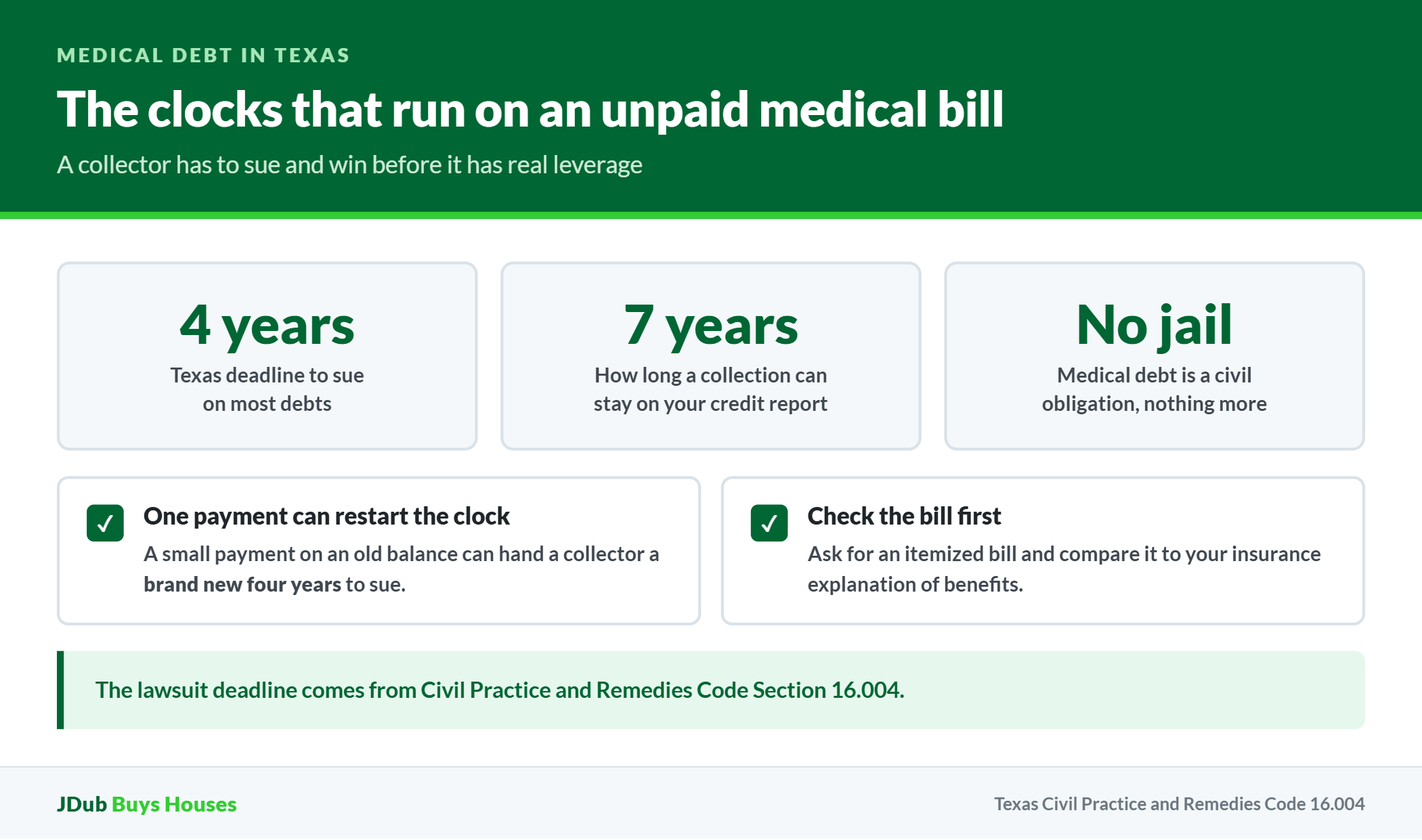
Medical debt in Texas is a civil obligation, nothing more. Nobody goes to jail over a hospital bill.
If the provider or the debt collection agency wants real leverage, they have to sue you and win a judgment, and they’re racing a clock that’s already running. A four-year statute of limitations on debt collection lawsuits is set by Texas under Civil Practice and Remedies Code Section 16.004. It runs from the date the cause of action accrues, and after that the debt is time-barred. One detail that trips people up: that window can restart with a single payment. So a well-meaning $25 payment on a five-year-old balance can hand a collector a brand new four years.
A federal court vacated the CFPB rule that would have banned all medical debt from credit reports in July 2025, so unpaid balances can still land on your report. A medical collection can stay there for up to seven years from the date of the original delinquency. You can read the breakdown of what survived that ruling at coveredusa.org.
What should you do first? Ask for an itemized bill and check it against your insurance explanation of benefits. I’ve watched families pay thousands on a balance their payor should have covered, simply because nobody filed an appeal.
Can Medical Bills Take Your House in Texas?
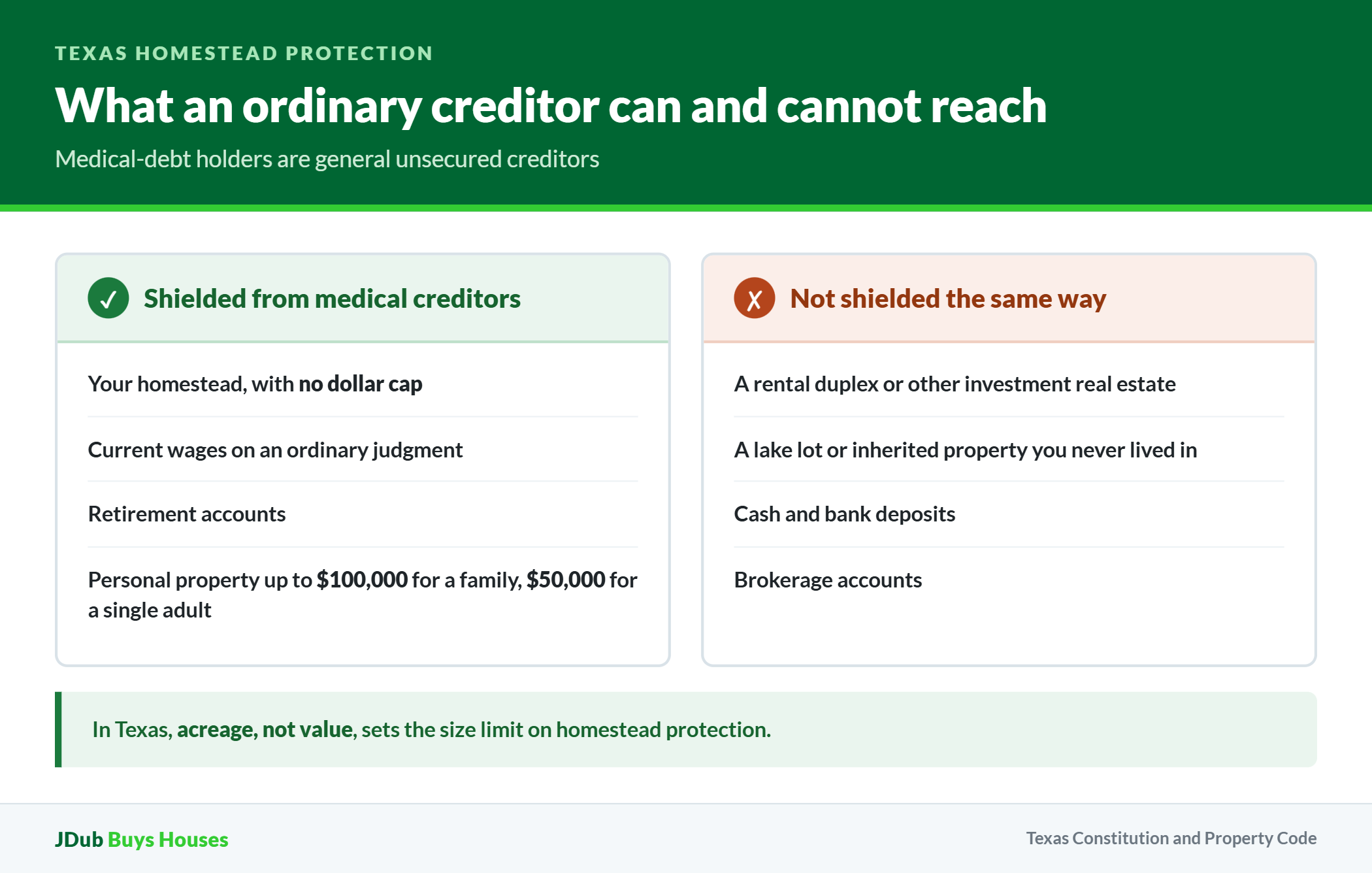
Zero. That’s the dollar cap on the value of a Texas homestead shielded from an ordinary unsecured creditor, meaning there isn’t one. A general unsecured creditor, including credit-card companies, medical-debt holders, and judgment creditors from ordinary lawsuits, cannot force the sale of a Texas homestead.
That protection runs deep. It’s written into the Texas Constitution, so the legislature can’t trim it back with an ordinary bill. Acreage, not value, is the size limit. In Texas, the size of your land, not its worth, sets the limit for homestead protection from creditors.
Here’s where the comfort stops. Homestead protection covers your homestead. A rental duplex in Beaumont, a lake lot, a bank account, an inherited property you’ve never lived in: those aren’t shielded the same way. No exemption exists in Texas for cash, bank deposits, brokerage accounts, or investment real estate. So the honest answer to whether they can take your house in Texas is: not your homestead, but your other assets are a different conversation.
Does Texas Law Protect Your Home From Medical Debt?
A retired couple in Abilene reached out after a judgment landed from a cardiac stay their insurance partly denied, and I’ve seen this panic before in other sellers facing a sudden lien. They wanted to sell immediately, before anyone could “take it,” and they would have left real money on the table doing it.
Already, the law was on their side.
A layered system, not one statute, protects the homestead under Texas law. It’s a constitutional framework reinforced by the Property Code and the Tax Code, and the forced-sale protection shields a family’s primary residence from most creditors. Texas Property Code Section 41.001 generally exempts a homestead from seizure for creditor claims except for encumbrances that may be properly fixed on homestead property. The full text sits at the Texas Legislature’s statute site for the hospital lien chapter, and summaries from Texas law firms walk through what qualifies.
Purchase-money debt used to acquire the property, taxes due on the property, and qualifying refinance, home-equity, and reverse-mortgage debt can all punch through. A federal tax lien also reaches the home, because federal law overrides the state exemption. They appear on none of those lists.
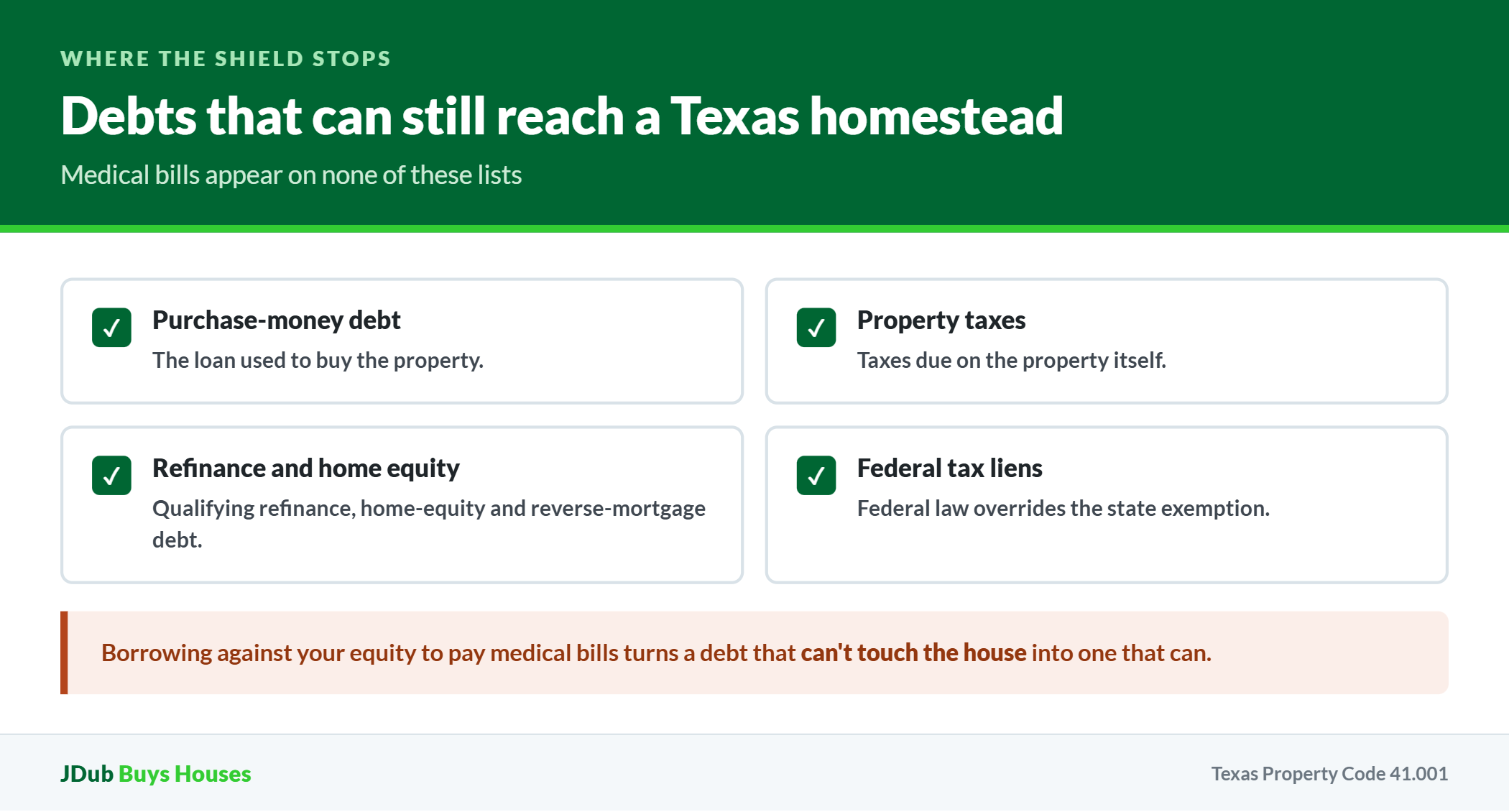
One trap is worth naming. If you borrow against your equity to pay off medical bills, you’ve converted an unsecured debt that can’t touch the house into a secured one that can. A home equity loan to clear a hospital balance moves the debt from the protected column to the foreclosable column, and Texas law won’t save you from a choice you signed.
I’d rather see a homeowner sell on their own timeline than mortgage protected equity to chase medical bills.
How Does Texas Homestead Exemption Protect Against Medical Bills?
“Do I have to file something to get this protection?”
Under Texas homestead law, creditor protection begins automatically once you meet the requirements. You living there and treating it as your primary residence does most of the work. Courts look at overt acts: living at the property, keeping your belongings there, carrying on ordinary residential life, calling it your homestead in documents, and claiming the property-tax exemption.
Two different things share the word “exemption,” and confusing them costs people sleep. One is the forced-sale shield against medical bills and other unsecured claims. Meanwhile, the other trims your property tax bill. A tax exemption and constitutional homestead protection aren’t identical concepts, and the absence of a tax exemption doesn’t mean constitutional homestead rights don’t exist. The school-district residence homestead exemption now stands at $140,000 under the Texas Tax Code. FindLaw’s Texas homestead page lays out both halves.
Can you file a formal designation? Yes. Under the Texas Property Code, that designation must be signed, acknowledged, filed with the county clerk, and recorded in the county deed records.
Bankruptcy is where Texas homestead protection really separates from other states. Texas lets bankruptcy filers use the state exemption system rather than the federal one, and its homestead exemption has no dollar cap for property meeting the acreage requirements. A federal homestead cap may apply, that said, if you recently acquired the property or moved there. Anyone considering bankruptcy protection over medical bills should talk to a local bankruptcy attorney before filing, because the timing rules in the Bankruptcy Code matter.
Can a Hospital Put a Lien on Your House in Texas?
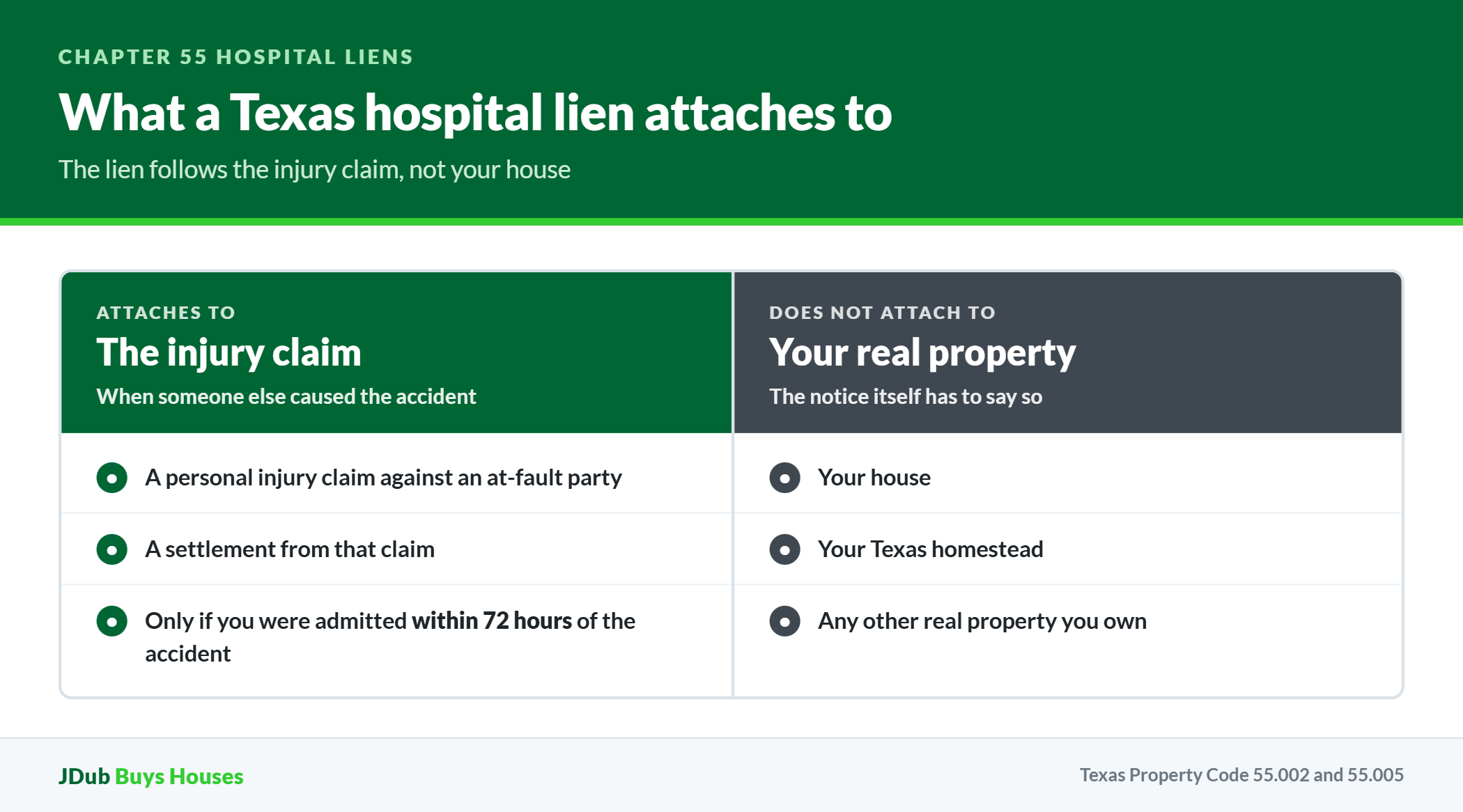
Texas has a hospital lien statute, and it’s narrower than its reputation. Under Texas Property Code § 55.002, a hospital has a lien on the cause of action or claim of a person. This person receives hospital services for injuries caused by an accident attributed to another person’s negligence. For that lien to attach, you must have been admitted no later than 72 hours after the accident.
The statute itself forces the hospital to tell you it can’t reach your home. The hospital’s notice must state that the lien does not attach to real property you own; a Chapter 55 lien follows the injury claim, not your house. It attaches to one thing: a personal injury claim or settlement against a third party who caused the injuries, such as an at-fault driver. You can read the requirement at FindLaw’s copy of § 55.005.
So when medical bills from a wreck on I-35 turn into a lien notice, that lien is aimed at your settlement money. Not your Texas homestead.
Where it gets murkier is a judgment lien. A creditor who wins in court can record an abstract of judgment in the county records. That abstract generally doesn’t attach to a properly established Texas homestead, but it can cloud a title search and create headaches at closing. I’ve seen sales in Texas slow down for weeks while a title company sorted out whether an old abstract ever attached to anything.
Does that mean you should ignore collection letters? No. Addressing medical bills early keeps your Texas closing clean.
Can Medical Debt Collectors Seize Your Property in Texas?
For years I assumed a judgment over medical bills meant a collector could garnish a Texas paycheck like they do in other states. Wrong.
Current wages cannot be garnished on an ordinary judgment in Texas. That protection is constitutional too, and it matters more for most households than the homestead rule, since wages are what actually pay the bills.
Personal property gets a generous carve-out as well. The personal-property exemption covers $100,000 for a family and $50,000 for a single adult.
But the shield has a real edge. Wages and a homestead are largely protected, though bank accounts and non-exempt property aren’t. Once wages land in your checking account, the protection gets complicated, and a judgment creditor can pursue those funds. Retirement accounts, many personal belongings, and certain vehicles are protected from most debt collectors by law in Texas; a brokerage account is not.
The state also regulates collector behavior. Under Texas law, collectors cannot publish your debt publicly or harass you, and the Texas Attorney General’s office takes complaints about debt collection abuse. If a collector working medical bills threatens to seize your home here, they’re either misinformed or lying, and that threat itself may be actionable.
One more piece of leverage people forget: nonprofit hospitals operate financial assistance policies under federal rules, and many Texas systems will discount or erase a balance for qualifying patients.
Will Unpaid Medical Bills Force You Into Foreclosure?
A hospital wins a judgment, files paperwork, and your mortgage servicer starts foreclosure. That isn’t how foreclosure works in Texas.
Foreclosure here comes from a lien properly fixed to the property: your mortgage, a home equity loan, delinquent property taxes, or a valid contractor’s lien. Homestead protection only fails against creditors who hold a lien on the property. Medical bills create no such lien.
A long hospitalization stops income. The mortgage payment slips. Six months later you’re in default, and the foreclosure notice that arrives has nothing to do with the hospital and everything to do with the missed payments. That’s the real connection between medical bills and losing a home in Texas, and nobody warns people about it.
Homeowners often underestimate how much timing matters, because the market isn’t moving fast right now. The typical Texas home sold in 99 days in the third quarter of 2026, two days slower than the same stretch of 2025, according to the Texas REALTORS® quarterly report. Add closing time to that and a traditional listing can easily run four months from sign in the yard to money in your hand. If you’re already behind on a mortgage while fighting medical bills, that math gets tight.
Sellers are seeing softer prices too. Statewide active listings rose 2.8% year over year as the Texas median sales price slipped 0.4% to $333,628 in the third quarter of 2026. More competition, flatter pricing. Houston Agent Magazine covered the full report if you want metro-level detail.
Would I tell someone to sell a Texas home purely because of medical bills? No. The homestead protection makes that unnecessary. But when the illness also ended the income that carried the mortgage, selling before default beats selling after.
What Are Your Options When Medical Bills Threaten Your Home?
“If the law already protects my house, why would I sell at all?”
Fair question, and for plenty of Texas homeowners the answer is you shouldn’t. The reason to sell is almost never the medical bills themselves. It’s everything around them: a two-story house you can’t climb anymore, a mortgage built on income that disappeared during treatment, a property three hours from the family who’s now caring for you.
Start by pulling apart the debt itself. Request the itemized statement, appeal anything your insurance carrier denied, and ask about charity care. If the services were emergency or out-of-network, federal balance billing protections under the No Surprises Act may cap what you owe, and the Texas Department of Insurance handles complaints about state-regulated plans. A consumer attorney can also tell you whether a lawsuit over old medical bills is already time-barred.
If the house genuinely has to go, you’ve got two honest routes in Texas. List it with an agent and accept the timeline, the showings, and the repair requests. Or sell directly to a local buyer who takes the property as-is and closes on your schedule. We built JDub Buys Houses around the second path, and I’ll say straight out that it isn’t right for everyone. If your home is updated and you can wait out the market, an agent will likely net you more.
No lender underwriting, no appraisal gap, no buyer walking at day 40.
A seller in Harlingen had been quietly covering two mortgages for close to a year after moving in with her daughter following surgery, never telling anyone, just draining savings every first of the month. The old house still had her late husband’s woodworking bench in the garage and a leak nobody had looked at since the previous winter. She closed on a Thursday, kept the bench, and left the rest. Her medical bills didn’t disappear, but the bleeding stopped.
Frequently Asked Questions
What Happens to You If You Never Pay Your Medical Bills in Texas?
You’ll hear from collection agencies, your credit may take a hit, and the provider can sue you within the limitations window described above. What won’t happen is a forced sale of your homestead, and your paycheck is shielded from garnishment on an ordinary judgment. The practical damage lands on your credit and your bank account, not your Texas home.
Can Your Children Inherit Your Medical Debt?
Not personally. Medical bills belong to the patient, and children don’t take on a parent’s debt simply by being family. What can happen is that the estate pays valid claims before heirs receive anything, so an unpaid hospital balance may reduce what’s left. If you co-signed for the care or live in a situation involving community property, talk to a Texas probate attorney about how your facts apply.
Do Old Medical Bills Just Disappear After Seven Years?
The seven-year figure refers to credit reporting, not to whether you owe the money. A collection account falls off your report after that period, and the lawsuit deadline discussed earlier is a separate, shorter clock. The debt itself can still exist, and a collection agency may keep asking you to pay voluntarily even when it can no longer sue.
Should Unpaid Medical Bills in Collections Worry You?
Worry is the wrong word; attention is the right one. Medical bills in collections can hurt your ability to refinance or qualify for a new mortgage, and ignoring a lawsuit summons is how a manageable balance turns into a judgment. Respond to court papers, dispute errors in writing, and ask about financial assistance before you assume the number on the letter is final.
Does Selling Your House in Texas Expose the Proceeds to Medical Bill Collectors?
Texas law protects homestead sale proceeds for a limited window after closing, which gives you time to reinvest in another homestead. That protection isn’t permanent, so parking the money in a checking account indefinitely leaves it exposed in a way the house never was. If you’re selling with medical bills outstanding, get advice from a Texas attorney about handling the proceeds before you close.
If you’re sorting through medical bills and wondering what to do with a Texas house that no longer fits your life, I’m happy to talk it through. That holds even if selling turns out to be the wrong move for you. Call us at JDub Buys Houses, ask your questions, and walk away with a clearer picture. No pressure, no obligation, and no offer you have to accept.
Selling a House in Amarillo While Medical Bills Pile Up
We buy houses in Amarillo, and hospital debt is one of the reasons sellers call us. Amarillo listings had a median asking price of $285,000 in October 2026, and the typical one had already sat for 38 days. A house that needs work can sit a lot longer than that while the hospital keeps mailing statements.
Our as-is offer works the same for homeowners across Texas, so it doesn’t matter which side of the state your house is on. You pick the closing date, and you don’t fix anything first.
Talk With Us Before You Decide
Medical bills don’t have to decide what happens to your house. If you want to know what a direct sale would look like next to a listing, reach out to JDub Buys Houses and ask us anything. You can also fill out the short form below, and we’ll get back to you with a no-obligation offer.
Helpful Texas Blog Articles
- Can you sell a House in Texas with a Tax Lien on it?
- Can I Sell My House for Less than Appraised Value in Texas?
- What Taxes Do You Pay When Selling a House in Texas?
- How to Sell a House with a Squatter in Texas
- Can You Sell Your House With A Quitclaim Deed In Texas
- Are Open Houses Still Effective For Selling Your Texas Home
- FSBO Costs And Fees For Texas Home Sellers
- How to Avoid Closing Costs in Texas
- How to Sell a Fire-Damaged House in Texas
- How to Sell a Fixer-Upper House in Texas
- How to Sell a House When You are Behind on Payments in Texas
- How Long Does It Take to Force the Sale of Property in Texas
- Selling Home With Reverse Mortgage Loan
- How Long Does a Real Estate Contract Last in Texas