
A homeowner in Tomball handed over keys on a Friday. On the following Tuesday, her buyer called about a water stain spreading across a hallway ceiling, and she spent the rest of the week wondering whether she owed him a new roof. I get asked about that exact phone call more than anything else, so let’s sort out when a Texas seller owes repairs after closing and when the sale is genuinely finished.
Most sellers I meet have this backwards. They think signing closing documents builds a wall between them and the house. In Texas, the law doesn’t quite work that way, though the wall is a lot sturdier than the panic suggests.
What Does a Texas Inspection Report Cover?
Before the inspection, a seller in Garland believed her house needed paint and nothing else. After the inspection, she held a 38-page document. It listed a double-tapped breaker, a sagging fence post, and an HVAC unit the inspector called “near end of serviceable life.”
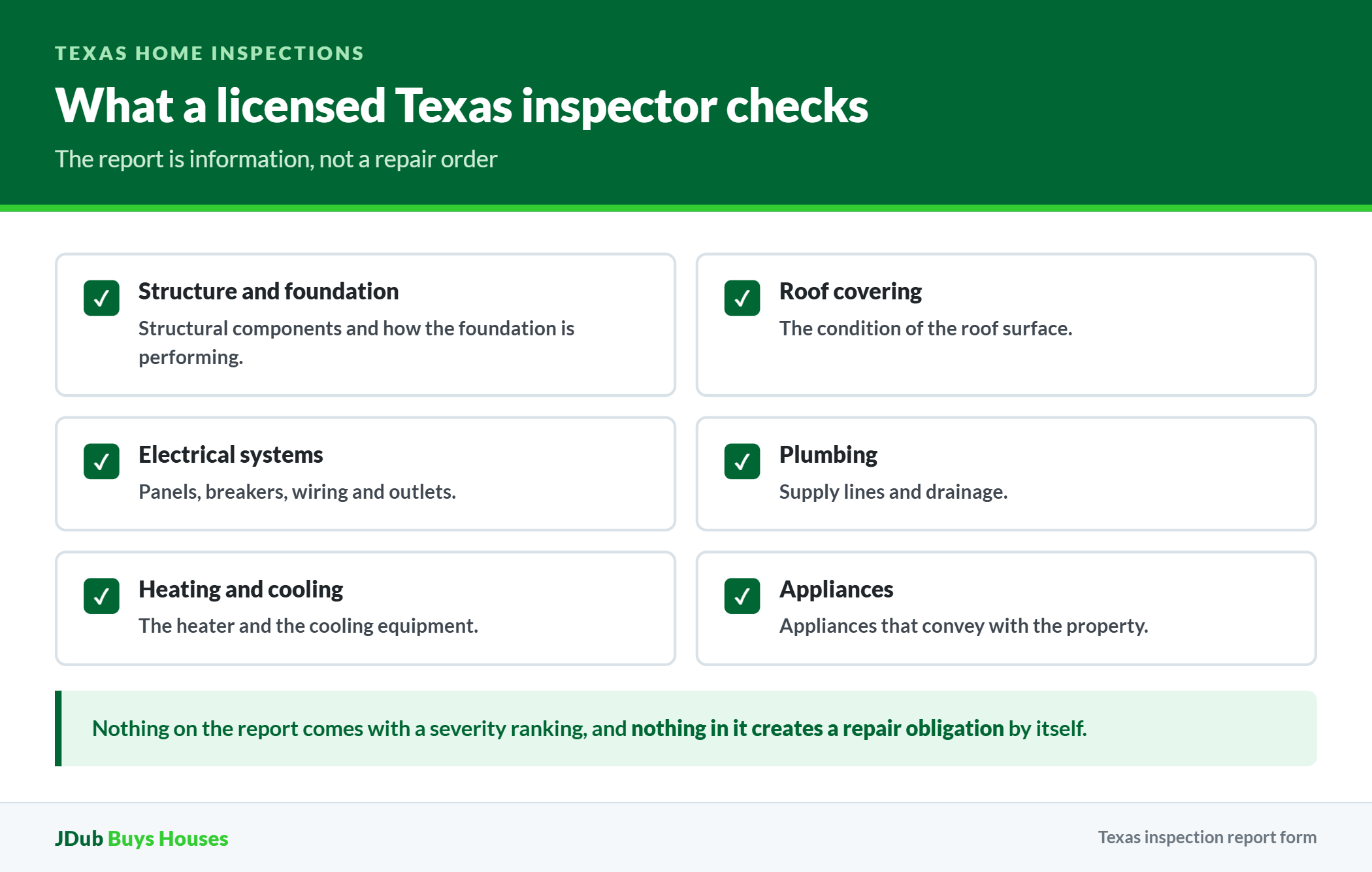
A standard report form guides Texas inspectors, pushing them to flag everything they observe. A licensed inspector in Texas checks structural components, the roof covering, the foundation’s performance, electrical systems, plumbing supply and drainage, the heater and cooling equipment, plus appliances that convey with the property. None of it comes with a severity ranking. A cracked outlet cover gets written up in the same font as a slab issue.
Information is all the document provides, not a repair order, and nothing in it creates a contractual obligation by itself.
Buyers in Texas use inspection findings to decide three things: whether to proceed, whether to ask for money, whether to walk. Sellers who read the report as a bill are negotiating against themselves from the first page. Permits and license numbers show up in these reports too, because an inspector will note work that looks unpermitted without confirming it with the city.
Does any of this obligate you for repairs after closing? Not on its own, no.
Does a Seller Have to Fix Everything on the Inspection Report?
Which brings up the number that actually governs the conversation: zero. That’s how many items a Texas seller is required to repair based purely on an inspection report, because the report itself carries no contractual force. Your agreement with the buyer does.
Repairs after an inspection get negotiated, they’re not automatically owed. Almost every resale in Texas runs on the TREC One to Four Family Residential Contract, and that form has the buyer accepting the property as-is unless a specific repair list is written in. “As Is” means the property in its present condition with all defects, though that agreement doesn’t stop a buyer from inspecting, negotiating repairs in a later amendment, or terminating during the option period.
Fix everything on a long report and you can spend four thousand dollars on contractor invoices for issues the buyer never cared about, and the lender still won’t fund a dime faster.
Lender-required repairs sit in a different box. Under Paragraph 7E of the TREC contract, neither side has to pay for lender-required repairs, termite treatment included, unless they agree in writing. If they don’t agree, the contract terminates and earnest money goes back. If those repairs exceed 5% of the sales price, the buyer may terminate.
So the real answer in Texas is that an inspection report never creates liability for repairs after closing. What creates liability is something you signed, something you concealed, or something you promised and didn’t finish, so everything else is just a conversation about price between two adults.
Can a Texas Seller Refuse Repairs Before Closing?
A buyer sends over a six-item repair request with a polite note, and the assumption on both sides is that the seller will knock out most of it. Then the seller says no. Nothing kills the sale, the buyer doesn’t sue, and the Texas market absorbs the standoff the way it absorbs most things: with a price adjustment.
Refusal is a contractual right. You can decline all of it, part of it, or counter with a different package entirely. The Texas Real Estate Commission explains the mechanics on its public FAQ page.
Leverage decides these standoffs, and right now in Texas that leverage has shifted. Dallas-Fort Worth listings had a median of 64 days on market in October 2026, according to Federal Reserve data, up from 51 days that June. Houston single-family homes averaged 59 days on market in October 2026 per the Houston Association of Realtors, with the median price down 3% to $320,000. Stubborn refusal costs more in that kind of market than it did in 2021.
Vague agreements are where repairs after closing actually get born. “Seller to address moisture intrusion at rear elevation” means nothing, and six months later two people read that sentence very differently.
Refusing has one more benefit worth naming. A Texas seller who performs no repairs makes no new promises, and promises are the thing that follows you past the closing table.
Can a Seller Offer Money Instead of Making Repairs Before Closing?
Money beats repairs almost every time, and Texas sellers should default to it.
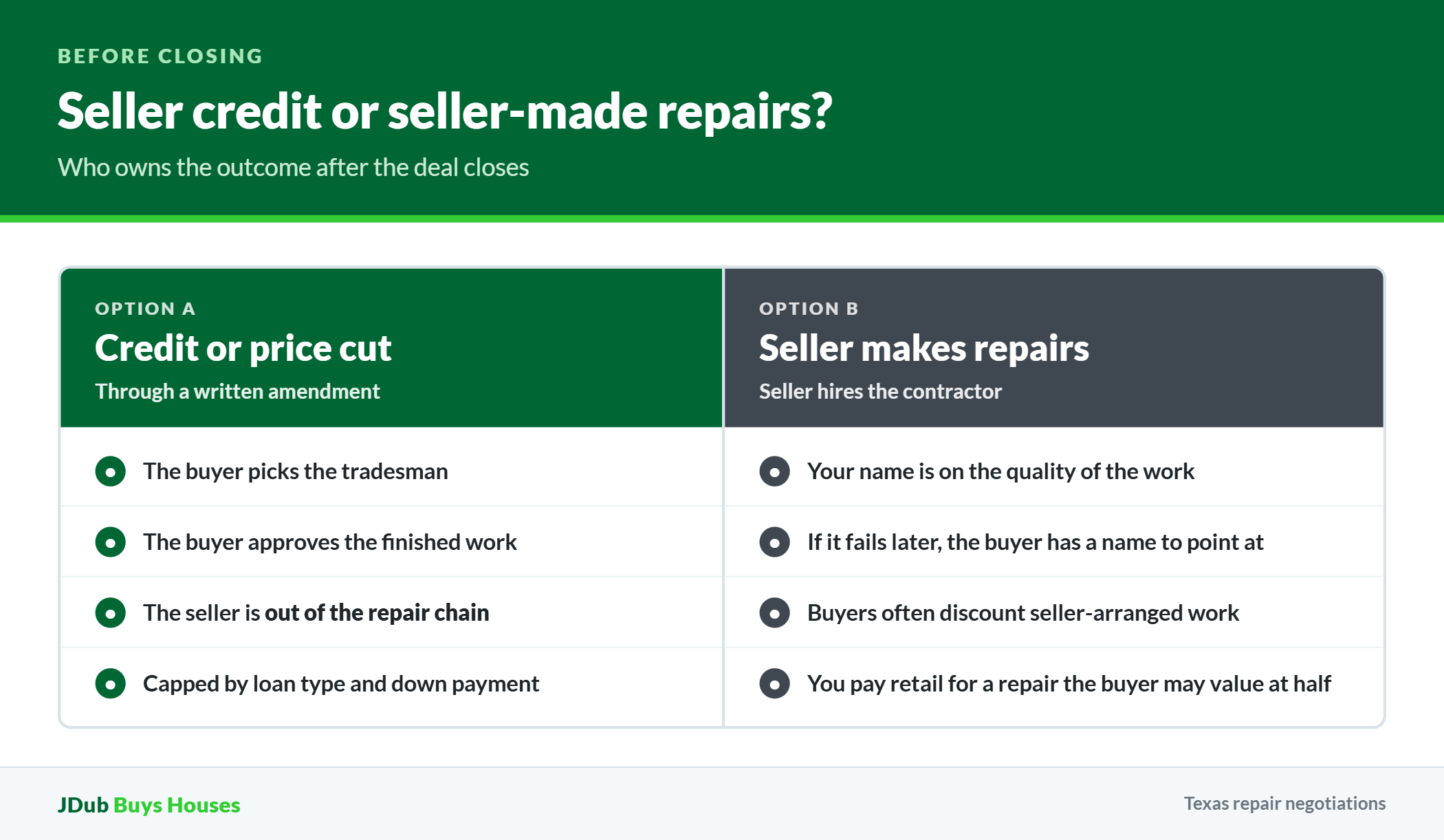
Once a buyer reviews inspection findings, they can request repairs or a seller credit through a written amendment. Price reductions and closing cost credits do the same work as a plumber without putting your name on the quality of the plumbing. The buyer picks their own tradesman, approves the finished product, and owns the outcome.
Credits have caps depending on loan type and down payment, and a credit that exceeds what the loan program allows gets kicked back during underwriting. Your title company will usually catch it. A home appraisal that comes in low adds another wrinkle, since a price cut and a credit affect the loan file differently.
Why should you care about this for repairs after closing? Because a credit transfers the problem along with the money. When a seller hires the HVAC company and that new condenser fails in August, the buyer has a name to point at. When the buyer hires the HVAC company, the seller is nowhere in that chain.
Paying for the work yourself is usually bad economics, because the buyer discounts seller-arranged work anyway and you’ve spent retail on a repair the buyer valued at half that.
One caution for Texas sellers taking the credit route: a concession doesn’t erase what you knew. Paying someone to go away doesn’t cure a disclosure you filled out wrong, and the money changes nothing about your statutory duties.
Does a Repair Request Guarantee Repairs Before Closing?
A repair request isn’t a contract amendment. That distinction constantly causes Texas sales to fall apart. An email from a buyer’s agent listing six items carries exactly as much weight as a text message until both parties sign the TREC amendment form.
Changing a signed TREC contract requires the amendment form, including adding repairs and moving the closing date. Verbal agreements between agents don’t bind anybody in Texas, and courts here have been consistent about that for real estate.
Timing squeezes everyone. The option period is fixed when the contract is signed, and inspection findings don’t extend it. Picture a seven-day option with the inspection landing on day five. Both sides now have about 48 hours to get a repair amendment drafted, negotiated, and signed.
Sloppy paperwork is the seed of most disputes over repairs after closing. Write the scope tight. Name the item, name the standard, name who pays. “Replace water heater” is fine; “service plumbing issues” is a lawsuit starter kit.
You also have to handle contractors who don’t finish agreed work on time. If the seller doesn’t complete the work before closing, the buyer can use the contract’s default remedies or extend closing by up to five days for it to get done. Rarely do Texas buyers push that button, but it exists.
How Do You Verify Repairs Were Done Right Before Closing?
How do I prove I did the work?
Receipts. Invoices on contractor letterhead with license numbers, dates, and a description matching the amendment language word for word. That paper file is your best defense against any claim about repairs after closing, and it costs nothing to assemble.
Buyers in Texas typically order a re-inspection before funding. The original inspector returns, checks the agreed items, and issues a short supplemental report. Smart sellers welcome that visit instead of resisting it, because a clean re-inspection report is documentation generated by the buyer’s own expert.
Permits deserve attention here. If you replaced a water heater or rewired a panel, pulling the permit in your city (Plano, McKinney, Pearland, wherever the property sits) converts private work into a public record. Unpermitted work is one of the most common sources of post-closing friction in Texas, since a buyer who later discovers it has a documented grievance.
The buyer’s final walk-through usually happens within a day or two of closing, and that’s the last clean chance to resolve a dispute while both parties still have leverage. The same disagreement three weeks later gets fixed by lawyers.
Keep everything for years, not months. Sellers who shred their file the week after closing lose the only evidence that would answer a question about repairs after closing. I tell every Texas seller I work with to scan the disclosure, the amendment, the invoices, and the re-inspection into one folder.
Is a Texas Seller Responsible for Repairs After Closing?
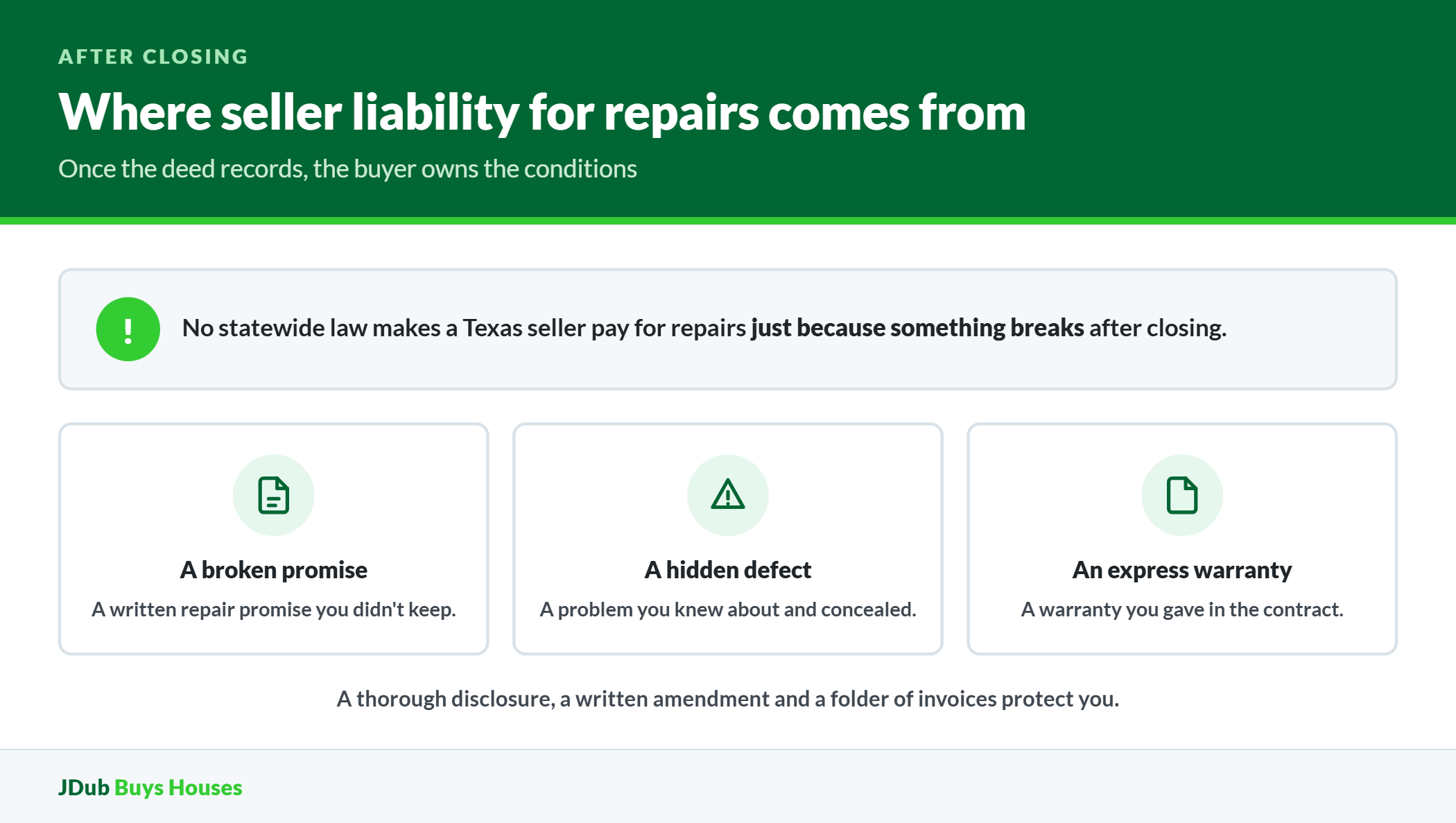
The general rule in Texas: once the deed records, the buyer owns the property and its conditions. There’s no statewide law making Texas sellers responsible for repairs after closing simply because something breaks.
You should weigh exceptions more than the rule. Liability for repairs after closing in Texas typically comes from one of three places. It’s a written promise you didn’t keep, a defect you knew about and hid, or an express warranty you gave in the contract. Courts in Texas generally enforce as-is clauses that disclaim reliance on prior representations, and those clauses can insulate sellers from liability for property conditions unless fraud or active concealment is proven.
Sellers trip over disclosure more than anything else in the transaction. Texas Property Code Section 5.008 requires sellers of residential property with not more than one dwelling unit to give buyers a written disclosure notice. The Texas Real Estate Commission publishes the standard Seller’s Disclosure Notice form. It contains the information Section 5.008 requires about material facts and the physical condition of the property.
Most Texas sellers never hear about this wrinkle. The Property Code doesn’t create a continuing duty to update the disclosure notice. But if the information in it stops being true, the seller’s got a common-law duty to correct any misstatement or false impression. The Texas Realtors association covers that point in its legal FAQ. So if your sewer line backs up during the option period, update the form.
Concealment is expensive.
What Happens If a Defect Is Found After Closing in Texas?
For years I assumed a buyer’s post-closing complaint meant the seller was about to get sued, and that’s rarely how it goes.
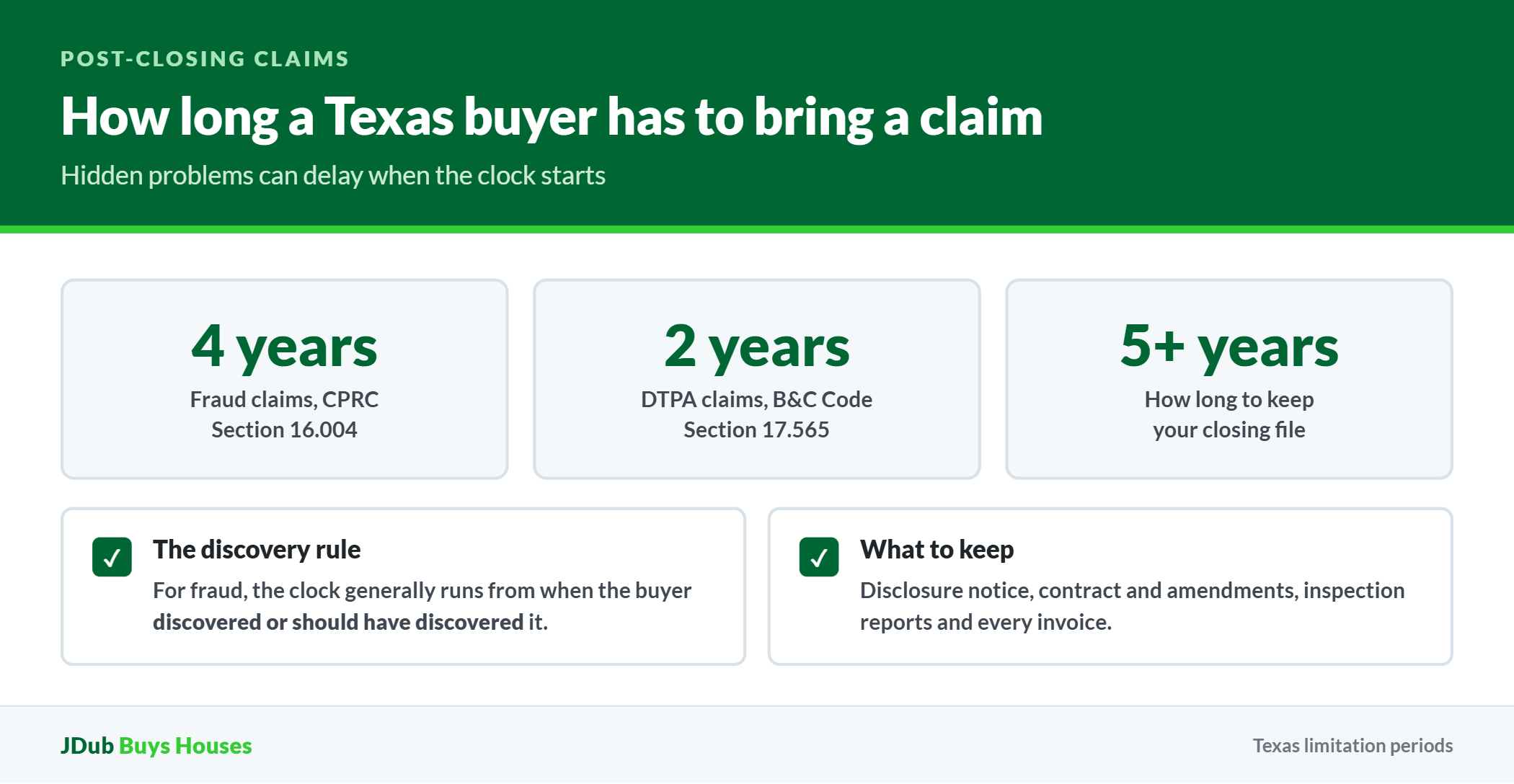
When something does escalate in Texas, the claim usually sounds in fraud, breach of contract, or the Deceptive Trade Practices Act. Under Texas Civil Practice and Remedies Code § 16.004, a four-year limitations period for fraud generally applies. Texas Business & Commerce Code § 17.565 provides two years for DTPA claims, subject to that statute’s terms and exceptions. Finding a defect years later doesn’t automatically mean a buyer is out of time, and it doesn’t automatically extend the deadline either, which is how one Texas firm’s limitations guide frames it.
Hidden problems can delay the clock. Texas applies a discovery rule to fraud claims, so the period generally runs from when the buyer discovered or reasonably should have discovered the fraud rather than from when the conduct happened.
What protects a Texas seller from exposure to repairs after closing is boring: a thorough disclosure, a written amendment, and a folder of invoices. I’ve never seen a seller with that file get seriously squeezed. The ones who get squeezed checked “no” on a disclosure item they’d paid a plumber to address two summers earlier.
A man called me on a Wednesday afternoon from Sugar Land about his mother’s house. She’d moved into assisted living the month before, the pool equipment hadn’t run since spring, and he was calling from his office between meetings because he had no bandwidth for a repair negotiation. He didn’t want to manage contractors across town; he wanted a date certain and a clean break. We bought it as-is, which meant no repair amendment existed to argue about later. That’s part of why some Texas sellers in similar spots call JDub Buys Houses instead of listing.
Frequently Asked Questions
Who Pays for Lender-Required Repairs Before a Texas Closing?
Neither side has to under Paragraph 7E of the TREC contract unless you both agree in writing. If you don’t agree, the contract ends and the buyer gets the earnest money back. Once you’ve closed, those items aren’t yours to fix unless you signed something saying they were.
Can a Texas Buyer Come Back for Repairs After Closing If the Seller Never Disclosed a Problem?
They can try, and the strength of the claim depends on what you knew. A Texas seller who genuinely didn’t know about a defect is in a far better position than one who patched something cosmetically and checked “no” on the disclosure form. Repairs after closing become a real legal exposure when there’s evidence the seller had knowledge and concealed it.
Does Selling As-is in Texas Protect Me From Repairs After Closing?
An as-is sale helps a lot, but it isn’t a force field. Texas courts enforce these clauses against buyers who later complain about conditions they could have discovered, though the protection falls away if fraud or active concealment is proven. You still owe the statutory disclosure, and as-is doesn’t excuse lying on it.
What If the Buyer’s Inspector Missed Something That Turns Up Later?
A missed item usually lands on the buyer, not on the seller as repairs after closing. Their inspector worked for them, they accepted the property’s condition in the contract, and a seller who disclosed honestly isn’t on the hook because a third party overlooked a cracked flue. Keep your own documentation anyway, since your file is what ends the conversation quickly.
Should I Hire an Attorney If a Texas Buyer Contacts Me About Repairs After Closing?
If the message is a question, answer it politely and share your records. If it’s a demand letter or mentions legal claims, talk to a Texas real estate attorney before you respond or agree to anything. A single conciliatory sentence in writing can be read later as an admission, and an hour of legal advice costs far less than the alternative.
How Long Should I Keep My Closing Paperwork?
Hold the disclosure notice, the contract and amendments, the inspection and re-inspection reports, and every contractor invoice for at least five years. That window covers the longer limitations periods discussed above with room to spare. Scan it all; a digital folder weighs nothing and answers almost any question a Texas buyer might raise later.
If you’re staring at a repair list you don’t want to tackle, we’re happy to walk through what your options look like. The same goes if you’d rather not spend two months wondering whether a buyer will circle back. We buy Texas houses in whatever condition they’re in, and we’ll tell you straight if listing would serve you better. No pressure, no obligation, just a real conversation whenever you’re ready.
Selling an Amarillo House Without a Repair Fight
We buy houses in Amarillo as they sit, so there’s no fight over repairs after closing, or before it. Amarillo listings had a median asking price of $285,000 in October 2026, and the typical one had already been on the market 38 days. Add an inspection, a repair amendment and a re-inspection, and that timeline gets longer.
The same as-is offer goes to sellers across Texas, wherever the house is. You choose the closing date, and the condition of the house is our problem, not yours.
Ask Us What Your House Is Worth As It Sits
If a repair request has you stuck, or you’d rather skip that part of the sale entirely, contact JDub Buys Houses and tell us about the property. You can also fill out the quick form below, and we’ll follow up with a no-obligation cash offer.
Helpful Texas Blog Articles
- Can you sell a House in Texas with a Tax Lien on it?
- Can I Sell My House for Less than Appraised Value in Texas?
- What Taxes Do You Pay When Selling a House in Texas?
- How to Sell a House with a Squatter in Texas
- Can You Sell Your House With A Quitclaim Deed In Texas
- Are Open Houses Still Effective For Selling Your Texas Home
- FSBO Costs And Fees For Texas Home Sellers
- How to Avoid Closing Costs in Texas
- How to Sell a Fire-Damaged House in Texas
- How to Sell a Fixer-Upper House in Texas
- How to Sell a House When You are Behind on Payments in Texas
- How Long Does It Take to Force the Sale of Property in Texas
- Selling Home With Reverse Mortgage Loan
- How Long Does a Real Estate Contract Last in Texas